Weather Lore Versus Forecasts: Testing Ten British Sayings Against Real Data
Two things can be true at once. A shepherd's rhyme can contain a genuine piece of meteorology, and it can still be a poor guide to whether you need a coat on Tuesday. British weather lore grew out of centuries of watching the same skies from the same fields, which makes some of it surprisingly sound and some of it hopelessly local. Modern forecasting works differently: it starts from a mass of observations, runs physical models forward through the atmosphere, and then a meteorologist interprets the result for your corner of the country.
So which sayings deserve a place on the kitchen wall, and which belong in a display cabinet of good intentions? Here are ten well-known ones, judged against how our weather actually behaves.
Why the old sayings survived at all
Most lore was built for a world without instruments. With no barometer and no radar, the sky, the wind and the behaviour of animals were all you had. The sayings that lasted tend to share three features: they describe something you can see, they concern the next few hours or a day, and they were right often enough to be worth repeating.
That last point is the trouble. Folklore has never been tested the way a forecast is. Nobody counts the mornings the cows stood up and it rained anyway, but everyone remembers the one that soaked the hay. The result is a set of rules that feel far more dependable than they are.
The ten sayings, tested
- Red sky at night, shepherd's delight — Worth keeping, in Britain, when the weather is arriving from the west.
- Red sky in the morning, shepherd's warning — The same principle reversed. Reasonable, with the same caveats.
- Mackerel sky, never long wet and never long dry — Partly fair. It signals unsettled air aloft, but says nothing about timing.
- A ring round the moon means rain — A decent short-range hint, since the halo is a genuine sign of approaching cloud.
- Rain before seven, fine before eleven — Weak. It cannot tell a passing shower from a front that will sit over you all day.
- When the wind is in the east — Half a point. Easterlies are often raw and stubborn, but hardly cursed.
- Cows lying down before rain — No consistent support. Cattle lie down to chew the cud and to escape flies.
- Swallows flying low — A grain of truth: insects drop lower when air is humid, and the birds follow their food.
- Oak before ash, in for a splash — No basis. Leafing dates track spring warmth, not summer rainfall.
- St Swithin's Day — Forty days of rain after a wet 15 July? Not a thing.
Red sky at night: the one worth keeping
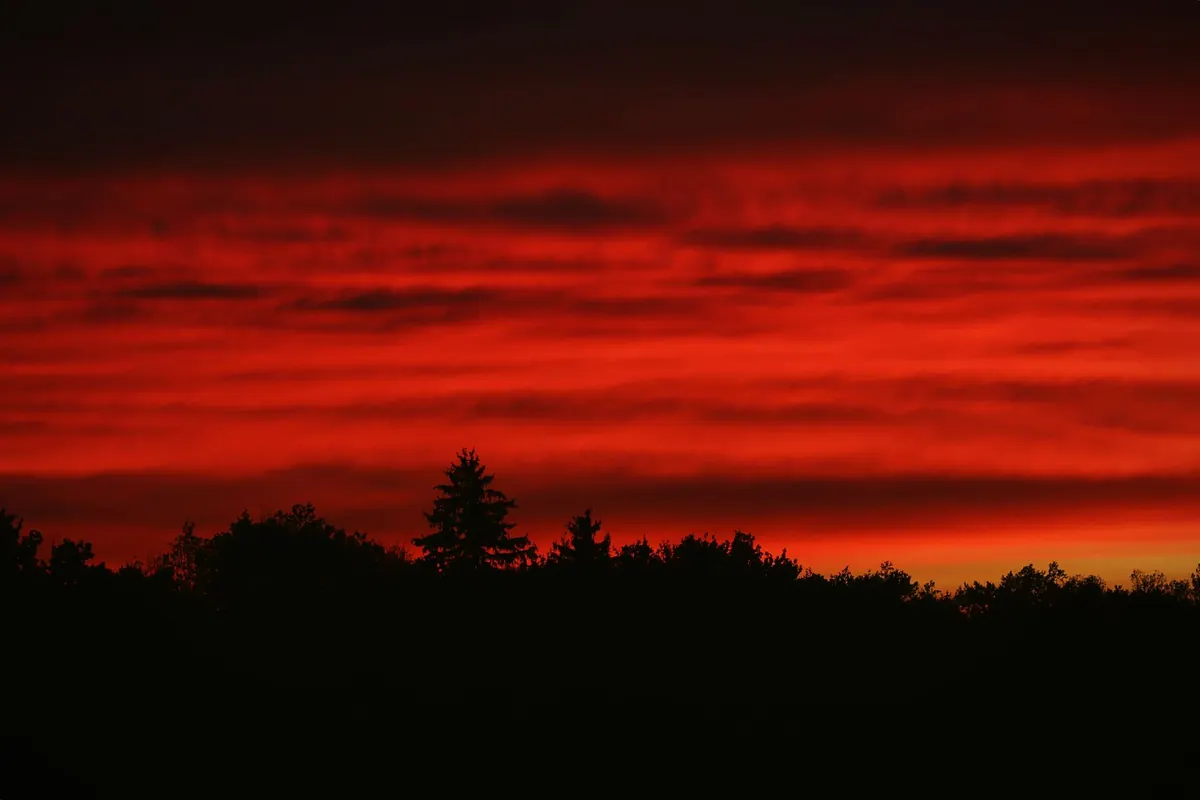
Red sky at night, shepherd's delight; red sky in the morning, shepherd's warning.
This is the saying with the strongest physical footing, and it is easy to see why. In Britain, most weather systems arrive from the west or south-west. A red sunset means the low sun is shining through a long stretch of atmosphere to the west, and that the western sky is clear enough for the light to reach you. Clear air to the west usually means high pressure is on its way.
A red dawn is the mirror image. The clear sky is to the east, which has already passed you, while cloud gathers behind. Rain is often on the way.
The catch is that the rule assumes the weather is moving west to east at a decent pace. In a brisk showery westerly, a red sky between showers is meaningless. In a blocked pattern, or when the wind has settled into the east, the rule can run backwards entirely. Treat it as a hint about the next twelve hours, never as a decision.
Sky signs: halos, mackerel and honest limits
A ring round the moon is a halo, formed by moonlight refracting through ice crystals in high, thin cloud. That cloud frequently arrives a day or so ahead of a warm front, which is where the rain connection comes from. The front may still pass to your north or south, so the halo raises your chances of a wet spell rather than guaranteeing one. It is a useful prompt to check the forecast before planning anything outdoors.
Mackerel sky — rows of rippled altocumulus — suggests moisture and instability at middle levels. The saying survives scrutiny mainly because it hedges both ways: never long wet, never long dry. Something will happen. That is not quite a forecast.
Animals, plants and the problem of proof
Cattle lie down for roughly half the day in any case, chewing and resting, and they move away from flies. Watching one field for one afternoon proves nothing. To test the saying properly you would need several herds, several weeks and a rain gauge, and the honest answer is that the link has never held up consistently.
Swallows and martins flying low is the more interesting case. Insects rise and fall with temperature, humidity and pressure, and birds feed where the food is. Low-flying swallows really can accompany muggy, unsettled air. But it tells you about the next hour or two near you, not tomorrow.
Plant lore fares worse. Whether oak or ash comes into leaf first depends heavily on species, soil and spring temperature. There is no sensible route from that to how much rain falls in August.
Where forecasts plainly win
A forecast has three advantages no proverb can match. It accounts for the whole atmosphere rather than your view of it. It updates several times a day as new observations arrive. And it gives you timing and likelihood: showers from mid-afternoon, clearing overnight, rain more likely in the west.
Skill does fall away with distance. The next day or two is usually dependable enough to plan around; by a week or more ahead, treat detail as a rough guide and expect changes. Even so, a five-day outlook beats any single sign in the sky for deciding on a wedding marquee, a long walk or a wash load.
Using lore sensibly alongside a forecast
- Check the forecast first, with the wind direction and the timing of any rain.
- Look outside. If the wind is south-westerly and the sky is turning red at dusk, enjoy the confirmation.
- Use lore for minutes and hours, not days: a halo, a halo of midges, dark cloud building to the west.
- Keep a small weather diary for a season. Note wind direction, cloud type and whether rain arrived. You will quickly learn which sayings suit your own patch.
- Ignore any saying that promises a season. No sign in July knows what October will do.
Weather lore is best treated as a set of low-resolution instruments you carry in your head. They are free, they need no battery, and red sky at night is genuinely worth knowing. But the sky is a hint and the forecast is the plan. Keep both, and you will rarely be caught out.
Photo: Nikola Tomašić / Pexels